As the TV world enters the era of RGB Mini-LED technology, is Samsung’s largest OLED still worth buying? The easy answer is yes. In this long-awaited review video, we’ll show you the tech behind the panel and the results of real-world content on screen.
WHY THE 83-INCH IS DIFFERENT
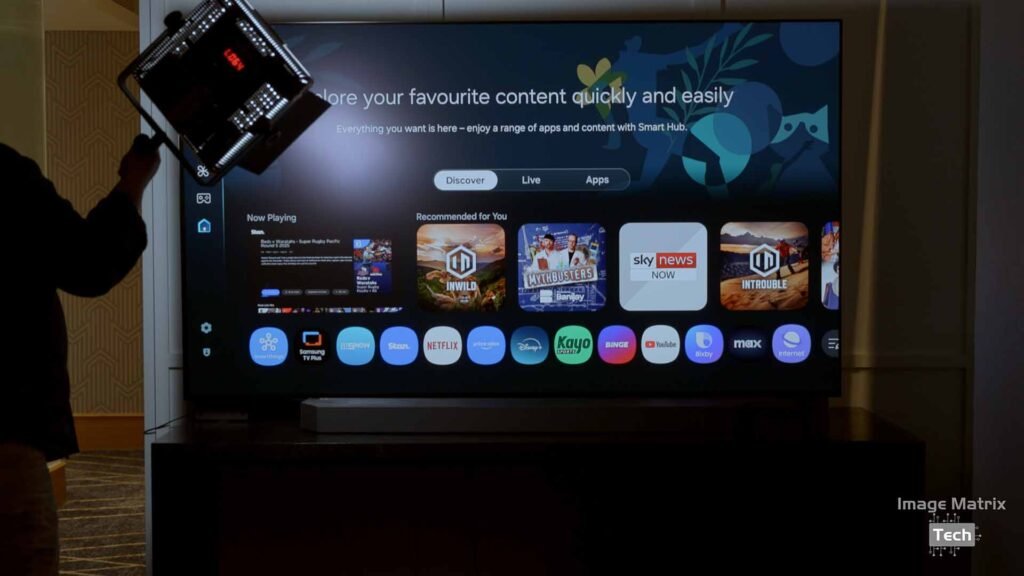
The S95F 83-inch OLED 4K is Samsung’s largest OLED, but it isn’t a QD-OLED. The smaller models, 77 inches and below, are QD-OLED panels. This is pretty easy to test when standing in front of a panel with a smartphone with macro camera capabilities. As you can see below, the white sub-pixel is obvious on the 83-inch model when compared with the QD-OLED’s RGB sub-pixels.
I tested the 77-inch QD-OLED version in another room, and the differences were minimal. But at high brightness, there was greater colour saturation in the QD-OLED. This is the power of Quantum Dot OLED panels. The reason the 83-inch model isn’t a QD-OLED is because that size isn’t available. Simple as that.
DESIGN
When it comes to design, Samsung’s top-end TVs are simply beautiful. In my opinion, no other TV maker comes close to the industrial fit and finish of Samsung’s elite televisions, and it’s been that way for some time now.
The S95F series is insanely thin, around 12 millimetres. It’s ideal for wall mounting because the one-connect box is separate from the panel itself. The one-connect box can be stored anywhere the owner likes as long as the cable reaches. It has four 2.1 HDMI ports.
The stand being in the centre means the TV wobbles when touched. It’s not going to fall over, so don’t worry about that. I actually prefer this design because I can use any size cabinet, which is not the case when the legs are at the ends.
GLARE FREE
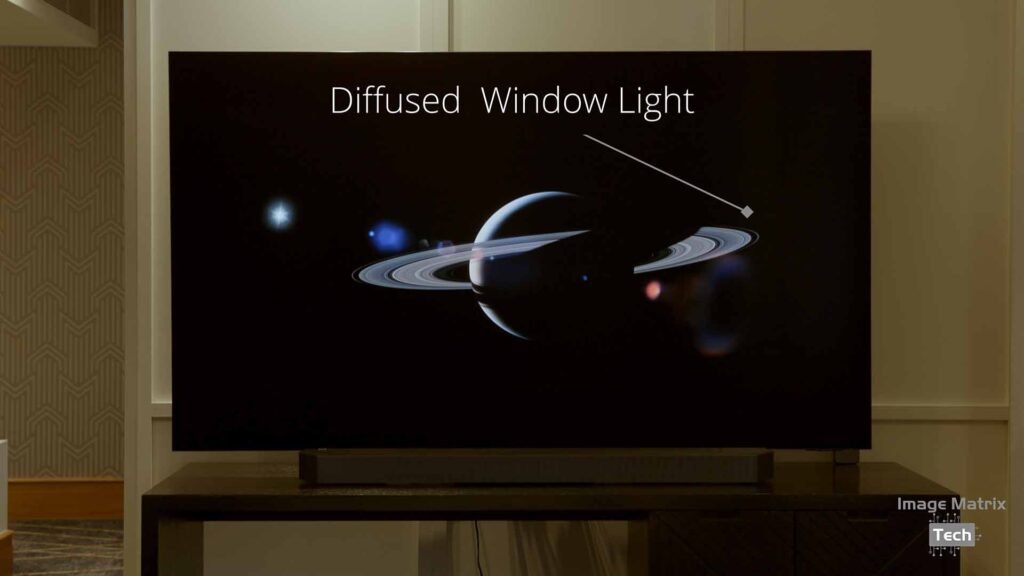
I’m here to tell you that matte screens are here to stay and the 2025 version of Samsung’s anti-glare coating is better than the year before. Samsung set up our review TV right next to big windows and mixed lighting sources.
Normally, all this mixed lighting would be a nightmare for a glossy screen. But not for the S95F 83-inch OLED.
This upgraded anti-glare display kills off all direct reflections. Instead, you’re left with a soft glow on the screen. Even when using a professional TV production light and blasting the screen, I’m amazed at how well the display transforms harsh light into diffused light.
Although this year’s matte coating has improved, there is still a compromise. You cannot have perfect blacks when a matte screen is struck by light. But … I found myself in the mindset where I didn’t really mind because it was just killing off the reflections and I knew that the really good viewing would come later.
Because when the lights go off – there’s absolutely no difference between this TV and one without glare-free technology. So if your premium viewing is in a dark room, at night, with some viewing during the day when you don’t want reflections – then this is your TV. I’m starting to like matte.
It certainly is a divisive technology one that you need to see firsthand before handing over your cash and you’ve got to hand over a lot for this TV.
PICTURE QUALITY
When it comes to picture quality, this is an elite TV, but you do need to be on top of the settings. The AI processing can be helpful, and if you don’t know what you’re doing, it is a good option.
AI customise is a quick way to dial in a look that you like. And that’s what matters – what you like. The scenes on the Enterprise in First Contact are almost always too red. But AI did a pretty good job balancing the image – colour and luma.
The out-of-the-box settings on all modes do need to be dialled in; most picture modes were not to my liking. Forget Dynamic and Eco, best to use Movie and Filmmaker modes – making adjustments as you go.
All modern HDR content looks amazing, while SDR and SD content can vary wildly in looks. AI can do some pretty amazing things, but there is a limit when it comes to upscaling low-res and low-bitrate video.
Sport is awesome using Movie or FILMMAKER mode – adjust motion to your liking. I’m not a fan of Black Frame Insertion or BFI – as the flicker gets to me.
Samsung says the S95F series is 30 percent brighter this year, and I can’t really argue with that – in fact, there were many times when the screens were too bright – a problem many people never thought they’d have with an OLED.
When it comes to gaming, the S95F is superb. I plugged in my Xbox and started blasting away in Far Cry 5. Still no Dolby Vision for gaming or movie viewing, but I didn’t really miss it. Sound is solid, but like all of these thin TVs… a soundbar is essential.
The big question is … is it worth buying an OLED as the market prepares to be swamped by new RGB Mini LED panels in 2026?
My answer is absolutely. First-gen technologies should be avoided unless you’re an earlier adopter.
VIDEO REVIEW PRODUCTION NOTES
- Reporter, Camera, Editor – Djuro Sen
- Canon R5 Mark II
- DJI Pocket 3
- iPhone 16 Pro Max
- Hollyland M2S
- Rode Wireless Go 3
- LightPro LED Panel
- DaVinci Resolve Studio on Mac