As Apple celebrates its 50th anniversary, I can’t help but think of my own journey with technology and how much Apple shaped my career through the products it made since 1976. Three days after Steve Jobs, Steve Wozniak, and Ronald Wayne founded Apple in a California garage on April 1st, I turned six. Ten years after that, I was in awe – with my nerdy mates – of the Apple IIe locked away in a special room at Inverell High School. A group of us were lucky enough to get access to it during lunch breaks and other times. It really was a special time for computers.
The next device to blow me away was the Macintosh. Although introduced in 1984, it wasn’t until the early 1990s that I got to experience it. But like Jobs himself, I wandered off from Apple. I spent the next decade or so in the world of Windows and bespoke computer systems for broadcast journalism before coming back to Mac. Don’t get me wrong, there have been plenty of issues along the way, but when Apple hit the turn of the century, it was hit after hit after hit.
Since the mid-2000s, I’ve been a Mac Pro user, iMac user, iPhone user, iPod user, iPad user, AirPods user, MacBook user, Mac mini user, and more. The Intel Macs changed my life as a content producer. Windows machines were unreliable, while Macs were dependable. So in a very real way, Apple changed my life for the better. And that’s happened again with the introduction of Apple Silicon. A true game changer for the industry.
Steve Jobs Legacy
If you want to get an idea of what their founder still means to Apple, just ask Siri about him on your iPhone. When I did, Siri said, “Thanks for asking about Steve. You can learn more about him at the Steve Jobs Archive.”
Now what does that tell you about his legacy, almost 15 years after his passing?
I’ve been dealing with Apple for a long time now as a customer and a journalist. One thing is clear: the legacy of Steve Jobs is undeniable. Tim Cook has taken the company to even greater heights, but there’s always a nod to the culture that Jobs set in the early days.
Jobs changed the business. He could be abrupt, cranky, arrogant, caring, insightful, inspirational, passionate, and more. But that’s what it took to get Apple off the ground and change the world.
Apple Timeline
The Early Years (1976–1984)
- Apple Inc. was founded on 1 April 1976 by Steve Jobs, Steve Wozniak, and Ronald Wayne in Jobs’ childhood garage in Los Altos, California.
- The Apple I & II: The company’s first product was the Apple I, a hand-built circuit board. Its successor, the Apple II (1977), became the first widely successful personal computer, featuring colour graphics and a plastic case.
- Going Public: Apple went public in 1980, creating more millionaires than any IPO since Ford in 1956.
- The Macintosh: In 1984, Apple launched the Macintosh with a famous “1984” Super Bowl ad. It was the first mass-market computer with a graphical user interface (GUI) and a mouse.
Internal Turmoil & Decline (1985–1996)
- Jobs’ Departure: Following a power struggle with CEO John Sculley, Steve Jobs was ousted from Apple in 1985. He went on to found NeXT and Pixar.
- Product Expansion: During the late 80s and early 90s, Apple released products like the PowerBook (1991) and the ill-fated Newton PDA. However, by the mid-90s, the company was nearing bankruptcy due to competition and a lack of innovation.
The Renaissance (1997–2010)
- Jobs Returns: Apple acquired NeXT in 1996, bringing Jobs back as interim CEO. He simplified the product line and introduced the translucent iMac G3 in 1998.
- $150 Million Investment: Microsoft bought non-voting, convertible preferred stock in Apple.
- The Mobile Revolution: Apple redefined itself with a string of era-defining hits:
- iPod (2001): Revolutionised the music industry along with the iTunes Store (2003).
- iPhone (2007): Transformed the mobile phone market and led to the creation of the App Store (2008).
- iPad (2010): Created a new category for tablet computing
The Modern Era (2011–Present)
- Tim Cook Leadership: Following Jobs’ death in 2011, Tim Cook became CEO. Under his leadership, Apple expanded its ecosystem with the Apple Watch (2015), AirPods (2016), and services like Apple Music and iCloud.
- Financial Heights: Apple became the first company to reach a $3 trillion market cap in 2022.
- Recently, Apple entered the mixed-reality market with the Vision Pro (2024).
iPhones in Space
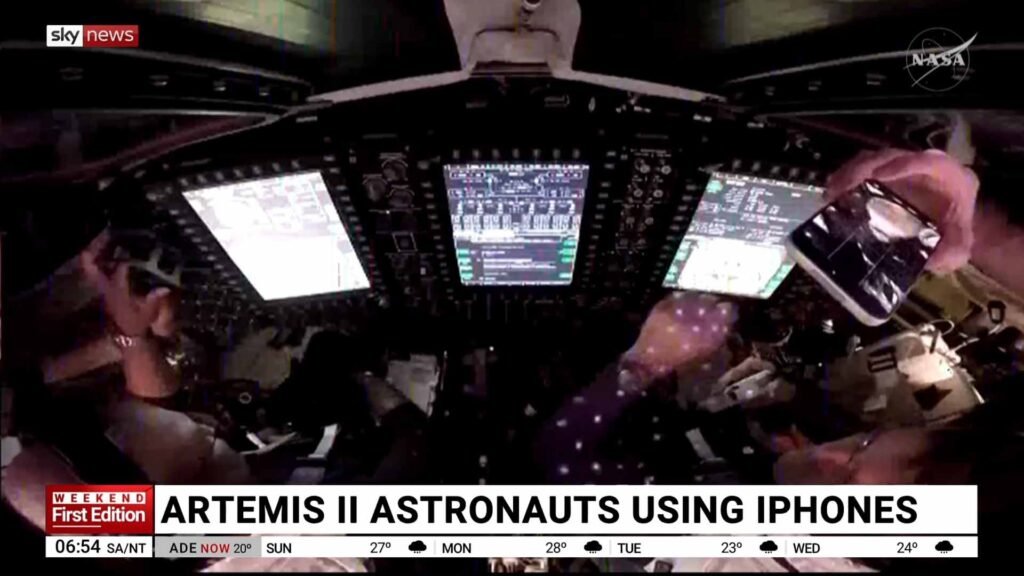
As you can see in the Sky News segment above, the iPhone 17 Pro has been spotted on the Artemis II Mission around the Moon. It literally takes the iPhone to new heights. iPhones have been to space before, but not like this. The astronauts are using their phones like any of us would on a trip across the country.
As far as celebrating 50 years, it doesn’t get much better than that for Apple.