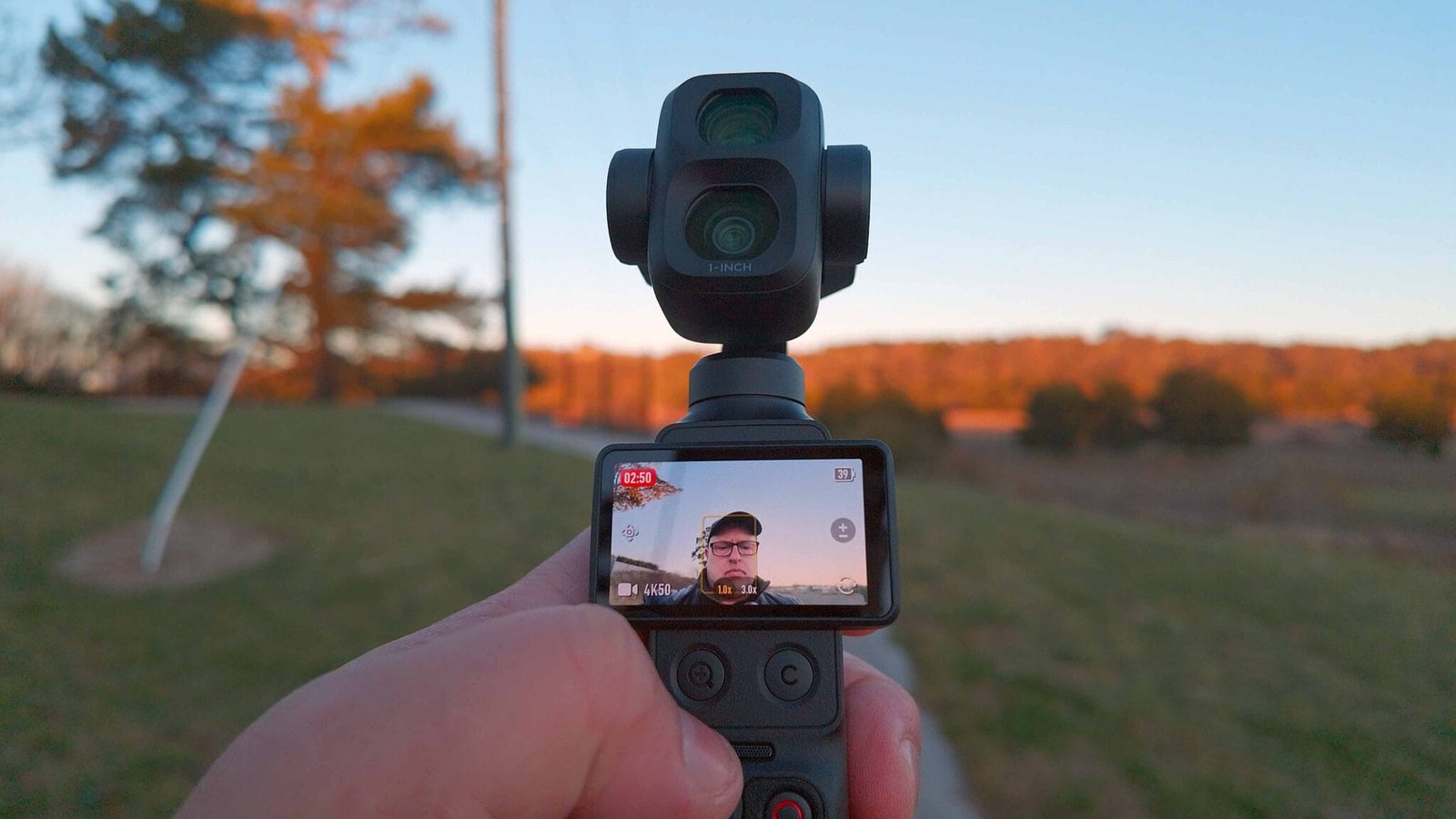



After months of teasing us, DJI has officially launched the Osmo Pocket 4P (Pro). The dual-lens gimbal camera is now available in Australia and other international markets like the UK, Canada, and Europe. Although Insta360 beat DJI to the market with its own dual-lens gimbal, the Luna Ultra, the Pocket 4P is set to be a big seller.
I own all of the DJI Pocket series. From the very start, I realised the potential of this gimbal camera. From my early testing, I’ve found that it’s now possible to take the 4P on the road as my only camera for ‘some’ assignments. The limiting factor before was the single wide lens. Well, not anymore. Skin tones are great, and action is excellent. Make sure you check out the fireplace video; it shows just how good the dynamic range and colour science is. So let’s see what DJI has delivered with the long-awaited Pocket 4P.
VIDEO REVIEW TO FOLLOW
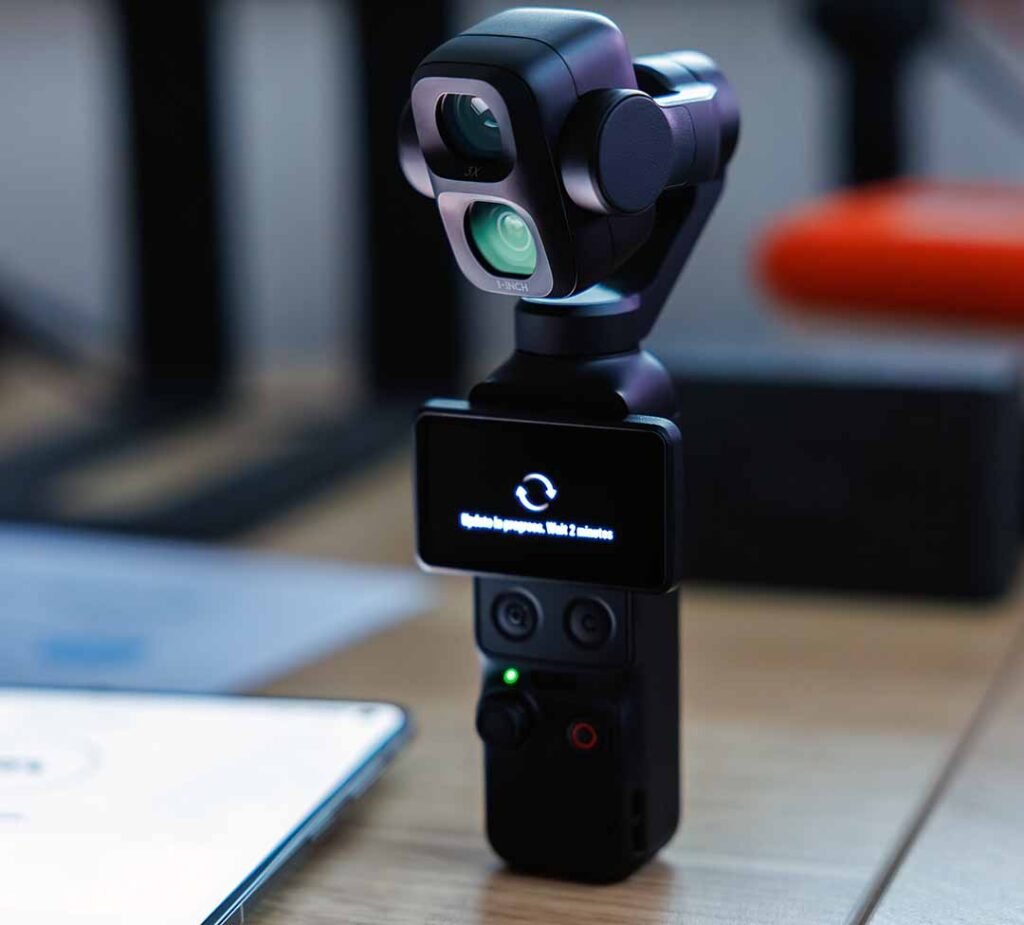
Dual-Lens Architecture
Having two lenses gives the Pocket 4P the ability to be an all-rounder. Just like a flagship phone but with motorised stabilisation built in. DJI has mastered the pocket gimbal format by including the following features and specs:
- The Primary Wide-Angle Lens: At the core of the system is an all-new 1-inch CMOS sensor. It boasts a 20mm format equivalent focal length paired with a fast f/2.0 aperture. Powered by cutting-edge LOFIC technology, this sensor unlocks an unprecedented 17 stops of dynamic range. This means the camera can effortlessly manage highly challenging lighting scenarios typically reserved for premium cinema cameras, such as deep city nightscapes, brilliant sunsets, and heavily backlit subjects.
- The Medium-Telephoto Portrait Lens: Accompanying the wide-angle module is a new high-resolution 60mm med-tele lens. This provides a classic focal length specifically engineered for standout portraiture. It features a large f/1.8 aperture, which yields an f/6.3 equivalent depth of field. This strongly compresses the background, pulling it closer to your subject and producing a beautifully blurred bokeh effect. Furthermore, it supports 3x optical zoom and pushes all the way up to 12x zoom. Although the zoom misses oiut
Image Quality and Colour Depth
The integration of DJI’s new 10-bit D-Log 2 colour profile is a massive bonus. The amount of flexibility that gives in post-production is insane for a camera of its size. The only downside is that you can’t select D-Log 2 with the longer lens. That means if you’re going to mix and match between the lenses, you are better off choosing the Normal Profile 10bit or D-Log 10Bit.
DJI reports a whopping 17 stops of dynamic range, which gives huge latitude when shooting shadows and highlights at the same time.
When it comes to action, the 4P has got you covered:
- Ultra-HD Slow Motion: The camera captures blistering 4K video at up to 240 frames per second. This allows creators to generate 8x ultra-HD slow-motion footage.
- Slow Shutter Video: This dedicated mode traces flowing light to create intentional motion blur. It is perfect for capturing movement trails and the hypnotic passage of time, adding a deeply unique visual narrative to your projects.
- High-Res Photography: The device snaps staggering 37MP photos, locking in crystal-clear details that give creators ample room to creatively crop and reframe during post-production.
- 4K Live Photos: Every still photo can automatically record a 1.5-second companion clip in pristine 4K resolution, instantly bringing your memories to life in motion.
Legendary Stabilisation Plus Next-Gen Tracking
The Pocket motorised gimbal has a big advantage over typical software-stabilised action cameras. No matter how dark it is, the Pocket will stay steady. Coupled with stability, DJI has integrated upgraded ActiveTrack 8.0 technology.
- Sticky Subject Tracking: Whether you are tracking people, erratic pets, fast-moving vehicles, or dynamically shaped objects, ActiveTrack 8.0 keeps the subject firmly centred in the frame.
- Zoom Compatibility: Incredibly, this sophisticated tracking remains perfectly reliable even when pushing the camera’s limits at 12x zoom.
- Intelligent Auto Framing: The system intuitively prioritises a registered subject, or it can automatically frame the shot to keep multiple subjects perfectly positioned at any focal length.
Fast Transfer Speeds
DJI is making it easier for creators to offload their content quickly.
- Storage Options: Like most DJI products in recent years the Pocker 4P has a microSD Card slot and 103 GB of live-saving internal memory!
- Auto Media Transfer to iOS devices: Newly captured footage can be automatically transferred to your mobile device after the camera is powered off. For best performance, DJI recommends pairing the camera with an iPhone 16 series or later running iOS 26.4.1 or above, and ensuring the camera’s battery level is above 15%.
- Fast Cable: With USB 3.1 support, wired data transfers hit speeds of up to 800 MB/s.
Easy Operation
- Instant Recording: Simply rotate the touchscreen to power the device on and instantly begin rolling footage.
- Auto Brightness & Colour Temp for the fill light: Once enabled, the fill light automatically adjusts its brightness and colour temperature based on the current scene, eliminating the need for frequent manual adjustments.
- Gesture Controls: Raise an open palm to seamlessly trigger ActiveTrack, or flash a “V” sign to start recording without ever needing to touch the device.
- Battery Efficiency: Fast charging can take the battery from 0 to 80% in just 18 minutes. On a full charge, the camera boasts an impressive maximum runtime of up to 210 minutes.
Pocket Ecosystem
The Osmo Pocket 4P is designed to be the core of a creator’s ecosystem. Available add-ons include the Osmo Pocket 4 Fill Light, Osmo Pocket 4P Black Mist Filter, Osmo Pocket 4P ND Filters Set, Osmo FrameTap, Osmo Pocket 4 Battery Handle, Osmo Pocket 4P Wide-Angle Lens, Osmo Mini Tripod, and various OsmoAudio microphones. These modular upgrades are sold separately or included in specific combo packages.
Pricing & Availability
The DJI Osmo Pocket 4P is available starting today, July 30, 2026. You can pick one up directly through store.dji.com/au or via authorised retail partners.
| Configuration | Price (Australian Dollars) |
| Osmo Pocket 4P Standard Combo | $959 |
| Osmo Pocket 4P Vlog Combo | $1099 |
DJI Pocket 4P v Insta360 Luna Ultra
While Insta360’s Luna Ultra grabbed headlines with its 8K video resolution and detachable touchscreen (which is awesome), DJI’s focus on colour science, dynamic range, and tracking gives it the slight edge. But it’s close, very close.
- Dynamic Range and Exposure: In high-contrast environments, the Pocket 4P retains more detail in the sky and shadows.
- Colour Profile: The Pocket 4P introduces a 10-bit D-Log 2 colour profile. This flatter profile preserves exceptional highlight and shadow information, offering more flexibility in post-production grading compared to the Luna Ultra’s i-Log.
- Skin Tones: In controlled lighting and studio setups, the Pocket 4P consistently produces cleaner and more natural-looking skin tones.
- Zoom Clarity: When pushed to its 12x digital zoom limit in backlit scenarios, the Pocket 4P retains more accurate colours and detail, whereas the Luna Ultra tends to push saturation. It looks good, but it might not be your cup of tea.
- Slow Motion: The Pocket 4P supports 4K recording at up to 240 fps (8x slow motion), providing substantially more headroom for action sequences than the Luna Ultra’s 4K at 120 fps cap.
These cameras are very closely matched, but right now, the Pocket 4 is in front. Let’s see if it can stay there as Insta360 continues to improve with updates.