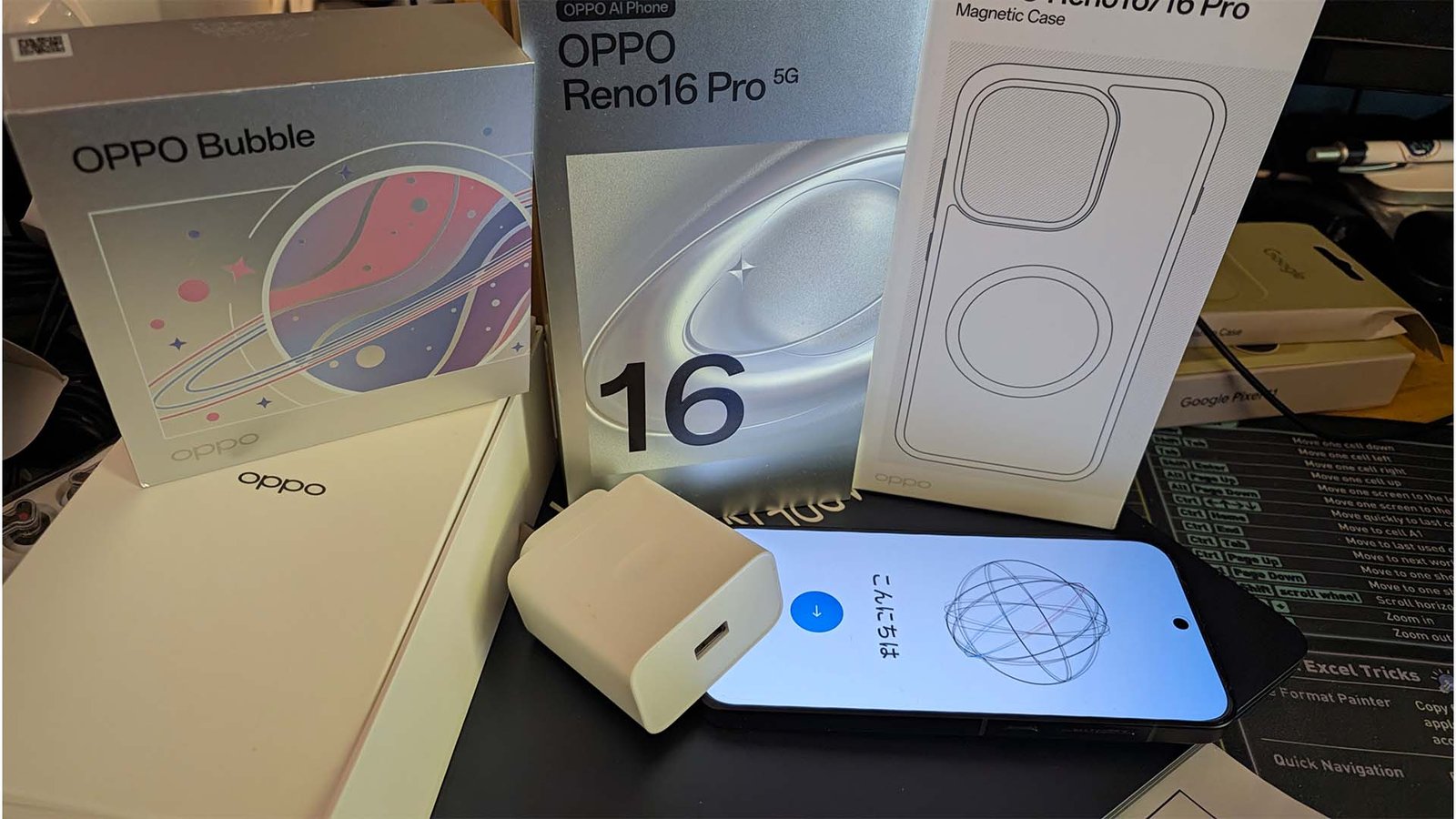


There was once a fairly obvious divide between flagship smartphones and everything sitting underneath them. Buy the flagship, and you received the best cameras, fastest processors, nicest displays and premium construction. Move down the range and the compromises became increasingly obvious, but the OPPO Reno16 Pro 5G makes that distinction considerably less clear.
The Reno series has traditionally occupied an interesting place in OPPO’s lineup, offering much of the technology found in its premium Find series devices without necessarily going all the way into flagship territory. The Reno16 Pro pushes that formula further, particularly with its cameras, display and battery.
At A$1,599 in Australia, this isn’t a phone that gets to hide behind the usual “mid-range” label when something is missing. It needs to stand on its own as a premium smartphone and, more importantly, provide an experience that justifies spending that much money.
Hardware and Design
One of the first things I noticed about the Reno16 Pro was something that doesn’t necessarily jump off the specification sheet: it’s refreshingly manageable.
Smartphones have become increasingly large over the past few years, particularly when you look at Pro and Ultra models. The Reno16 Pro instead uses a 6.32-inch AMOLED display and measures 151.2mm tall and 72.4mm wide. Depending on the colour, it weighs between 185 and 188 grams, with the Starlight Black model measuring 8.2mm thick. It isn’t a tiny phone, but next to many modern premium devices it feels remarkably compact.

The aluminium frame helps give it the premium feel you’d expect at this price, while OPPO has also given the phone IP68, IP69 and IP69K water and dust resistance. That doesn’t mean I’d deliberately go swimming with it, but it does add some reassurance that the phone is designed to survive considerably more than the occasional splash.
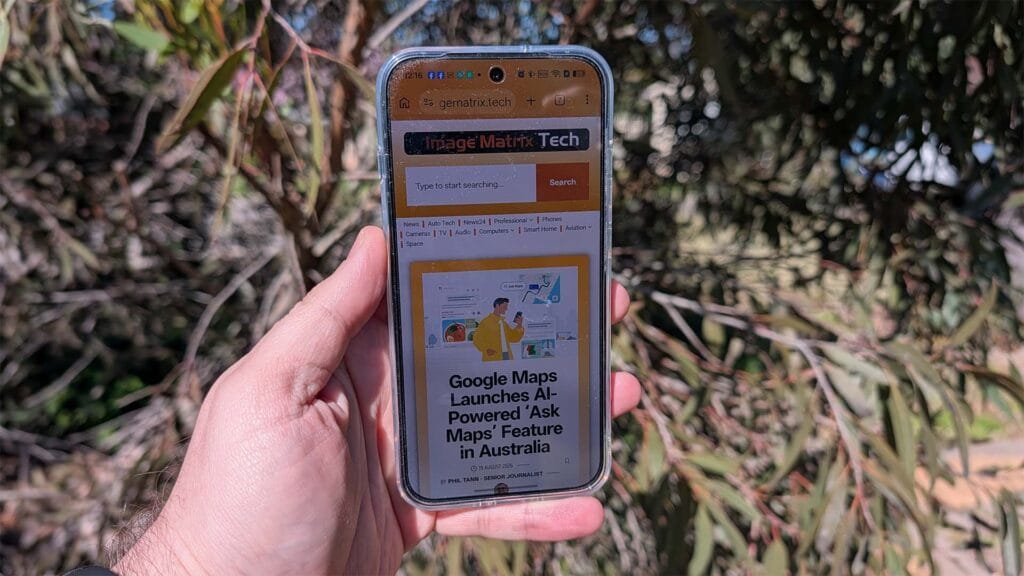
The display has a resolution of 2640 x 1216 and a pixel density of 460 ppi. It’s a 10-bit AMOLED panel supporting 60Hz, 90Hz and 120Hz refresh rates, with 144Hz available in supported gaming scenarios. High brightness mode reaches a claimed 1,800 nits, making it very easy to read outdoors, even in bright sunlight.
Inside is MediaTek’s Dimensity 8550 SUPER platform, paired in Australia with 12GB of LPDDR5X RAM and 512GB of UFS 3.1 storage. There’s no microSD expansion, although with half a terabyte of internal storage I don’t think that’s going to be a significant concern for many people.
The Dimensity 8550 SUPER isn’t necessarily about winning benchmark competitions against every flagship processor on the market. What matters more to me is whether the phone feels fast when I’m actually using it, and it does. Apps open quickly, transitions between applications feel responsive, and there’s more than enough hardware here for the everyday workloads most users will throw at their phone.
The 512GB storage is particularly welcome. Applications continue to get larger, photos and video continue to consume more space and shooting 4K video will chew through storage quickly. Starting with 512GB removes a lot of the storage anxiety that can come with owning a phone for several years, but content creators will need to be conscious of their space use before a day out shooting video.
Overall, the hardware feels much closer to flagship territory than the Reno name might initially suggest.
The Cameras
The cameras are probably where OPPO has made its biggest statement with the Reno16 Pro.
The main rear camera uses a 200MP f/1.8 sensor with optical image stabilisation. It’s joined by a 50MP ultra-wide camera and a 50MP telephoto camera with optical stabilisation and 3.5x optical zoom. The front camera is another 50MP unit with autofocus.
On paper, that’s an impressive collection.
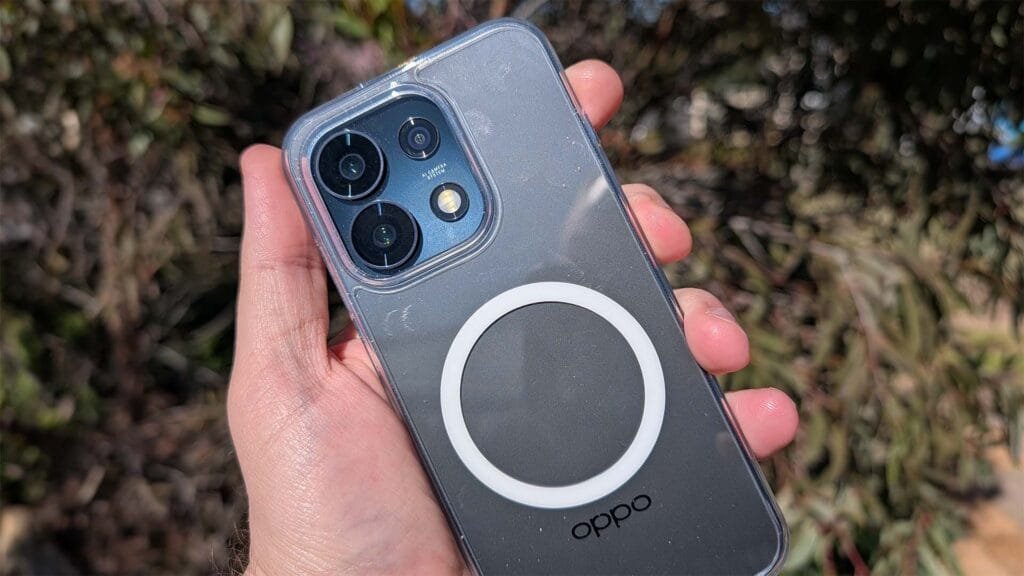
More importantly, there isn’t an immediately obvious filler camera included solely so OPPO can add another lens to the back of the phone. That’s something I’ve never particularly liked about smartphone camera marketing. A triple-camera phone isn’t necessarily a good camera phone when one of those cameras is effectively there to increase the camera count.
The 200MP headline number will inevitably attract attention, but resolution doesn’t automatically make a camera good. Image processing, colour reproduction, autofocus, stabilisation and how reliably you can pull the phone out of your pocket and capture a decent photograph are considerably more important.
While there’s plenty of settings and options available within the software, I’ve found it to be an exceptionally good point and shoot camera. Even in low light or quite challenging lighting conditions, the phone just makes the necessary adjustments and cleans up the image, giving really consistent results and usable, if not good quality, images.






The 3.5x optical telephoto is particularly useful. It provides enough reach to meaningfully change how you frame a photograph, rather than simply offering a slightly closer version of what the main camera already captures. I’ve increasingly come to appreciate having a proper telephoto camera on a phone. It’s useful for events, pets, landscapes, portraits, and those situations where physically moving closer simply isn’t an option.
Video recording reaches 4K at 60fps on both the rear camera system and the 50MP front camera. OPPO is positioning the Reno16 series heavily towards people creating social content and video, but you don’t have to consider yourself a “content creator” for a capable front camera and good video quality to be useful. Family videos, video calls, holidays and ordinary everyday moments benefit just as much.
Battery Life and Charging
One of the more impressive pieces of engineering in the Reno16 Pro is the battery. The Australian version has a 6,000mAh battery despite the relatively compact dimensions of the phone. That’s a substantial capacity to fit inside something only a little over 8mm thick.
Battery capacity is only half of the equation, though, and charging plays a big part in the overall user experience these days. I’ve long said that SUPERVOOC is the leader in phone charging; the Reno16 Pro continues that belief for me. When you do eventually need to plug it in, the Reno16 Pro supports 80W SUPERVOOC charging. OPPO claims a full charge in about 56 minutes under its test conditions; my real-world test was very close to that. After deliberately getting the phone down to 5% battery, it was back to 96% in 55 minutes.
That changes how you think about battery life and charging. My experience, in particular, became one of complacency, because even after heavy days of use, I had plenty of power left at the end of the day. Added to this, SUPERVOOC’s fast charging means you’re unlikely to run short on power. Instead of necessarily plugging the phone in overnight, I found it quite practical to give it a quick top-up while getting ready in the morning or before heading out. Added to this, with wired Android Auto in my car, I simply never ran out of power.
I know including a charger probably shouldn’t feel like a feature, but in an industry where spending well over $1,000 on a phone and receiving little more than a cable has become normal, there’s something refreshing about opening the box and actually finding the equipment required to take advantage of the phone’s fast charging.
Wireless charging is absent, however, and at $1,599 — and the hardware I’ve already spent money on to support wireless charging — I find that a little difficult to overlook, but the battery capacity and fast-charging capability somewhat override the need (or my desire) for wireless charging.
If you’ve never used wireless charging, it probably won’t matter. If you’ve already got charging pads around the house, office or car, it’s one of those missing features you’re likely to really notice.
Software
The Reno16 Pro launches with ColorOS 16, and OPPO’s Android interface has come a long way. Scrolling through websites, social media, photos and ColorOS feels fluid and responsive, which is exactly what I’d expect from a phone sitting at this price point.
I’ve used enough Android phones over the years to remember when manufacturer interfaces could genuinely make an otherwise good phone unpleasant to use, and ColorOS certainly isn’t that anymore.
It’s polished, fast and highly customisable without constantly feeling like it’s fighting against the core Android OS underneath it. Animations are smooth, menus are generally logical, and there are plenty of ways to personalise the experience without installing third-party launchers or spending hours adjusting settings. OPPO has also integrated features such as AI Mind Space and the new AI Snap Key into ColorOS 16 on the Reno16 series.
Unfortunately, there’s still some unnecessary baggage which I find frustrating. Out of the box, there are applications pre-installed that I simply don’t need, or indeed want, on my phone. TikTok is one example, along with various shopping applications and other promoted services. None of which are difficult to remove, but that’s not really the point. On a cheaper handset, I can at least understand the commercial reasoning behind pre-installed applications helping offset hardware costs; On a A$1,599 smartphone, I have considerably less patience for it.
The operating system itself is good enough that it doesn’t need this clutter, and removing some of that pre-installed software would make the initial setup experience feel considerably more premium. On the bright side, once I’ve removed what I don’t want, ColorOS 16 is genuinely pleasant to use.
And that’s probably the more important point. The software doesn’t feel like something you have to tolerate to access OPPO’s hardware anymore. It’s become one of the better parts of the overall OPPO phone experience.
User Experience and the AI Influence
This is also where we inevitably need to talk about AI, because apparently no piece of technology released in 2026 is allowed to exist without mentioning it somewhere. Unsurprisingly, OPPO has leaned fairly heavily into AI with the Reno16 series, particularly around photography, content creation and how information is organised on the device.
AI Mind Space can capture and organise information from the screen, while AI Mind Pilot is designed to use that saved information to provide more contextual assistance and potentially recommend different AI models depending on what you’re trying to achieve. There are also photography tools including AI Remix Collage and Popout Collage 2.0.
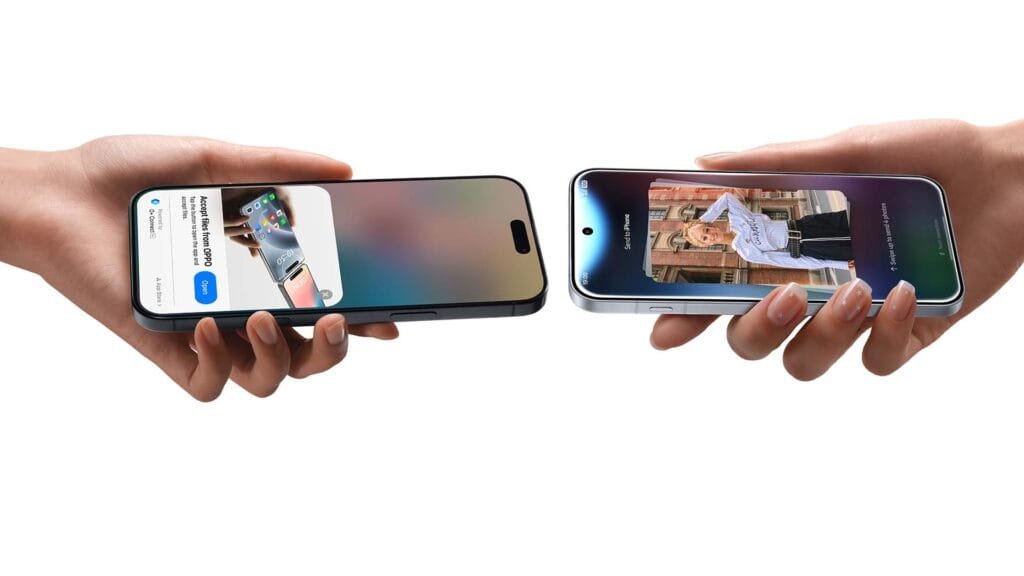
While some of this is genuinely clever implementation, I also think we’re reaching the point where AI features need to be judged on whether people actually use them rather than whether manufacturers can demonstrate them.
I’ve become increasingly sceptical of AI features that look impressive during a launch presentation, get used twice when the phone is new and then disappear into a submenu for the next three years. The useful ones are those that quietly make something I already do quicker or easier, or just do what they’re intended to without being invasive to the device’s experience.
Some of what OPPO implemented here was great and other bits needed more of a workflow adjustment than I could manage in the couple of weeks review time I had with the device. As I’m now in the habit of using Gemini on my daily driver (A Pixel device) for home automation and the integration into my calendar and other workflows, the use of Mind Space, which links in well, was easy
The Snap Key was a bit of a new take on an old theme; providing a key that can be programmed to do whatever you want it to. For my use case, I used the option to filter between silent, and audible notification modes. The ability to just reach into my pocket and set the phone to silent without taking it out is very welcome.
For me, however, the strongest part of the Reno16 Pro user experience isn’t necessarily AI. It’s simply that the phone gets the fundamentals right.
The relatively compact design is comfortable to use. The display is excellent. There’s plenty of storage. Performance is fast enough that I’m not thinking about the processor while using it, and the large battery means I’m not constantly watching the percentage indicator.
The Reno16 Pro would still be a very capable phone, even if you completely ignored every feature with “AI” written beside it.
Pricing and Availability
The OPPO Reno16 Pro 5G went on sale in Australia during July at an RRP of A$1,599 and is available in Pop White and Starlight Black through retailers including JB Hi-Fi, Officeworks, Harvey Norman and OPPO’s Australian online store.
Conclusion
The OPPO Reno16 Pro 5G is an interesting phone because I’m not entirely sure “upper mid-range” accurately describes the Reno series anymore. The argument in OPPO’s favour is that you’re getting 512GB of storage as standard, an unusually strong camera configuration, 12GB of RAM, a 6,000mAh battery, fast charging and a premium display in a relatively compact body.
You can buy something with a faster processor. You can buy something with wireless charging. You can spend more again and move into OPPO’s own Find series. But specification-sheet superiority doesn’t automatically make something a better phone for everyone.
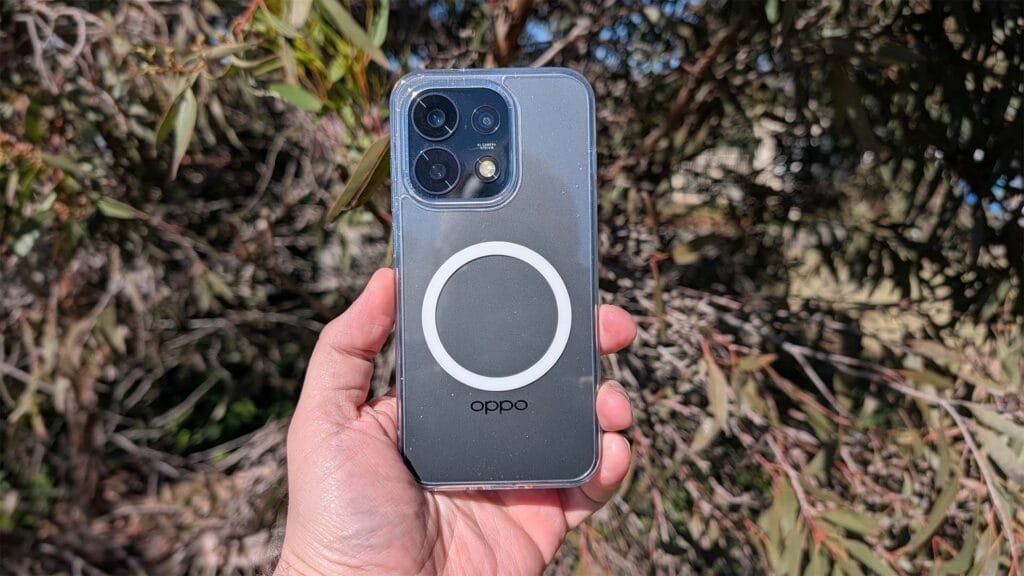
At the price, it has moved beyond being an easy recommendation simply because it offers good hardware for the money. It now needs to compete directly with established premium phones, and buyers should absolutely make those comparisons.
Some of the pre-installed software feels unnecessary on a device at this price, and wireless charging is probably the most obvious feature I’d like to see added. Neither of these points, however, completely undermines the experience, because after spending time with the Reno16 Pro, what stands out isn’t a single headline feature. It’s how few compromises I actually notice while using it.
The phone is fast, the screen is excellent, the battery is enormous for its size, and the camera hardware is far more ambitious than I’d traditionally expect from a Reno. I feel like this shows that the line between the mid-tier and top-range phones is blurring, and to me, that’s ultimately what the Reno16 Pro represents: minimal compromise on features, great savings, and an excellent user experience.