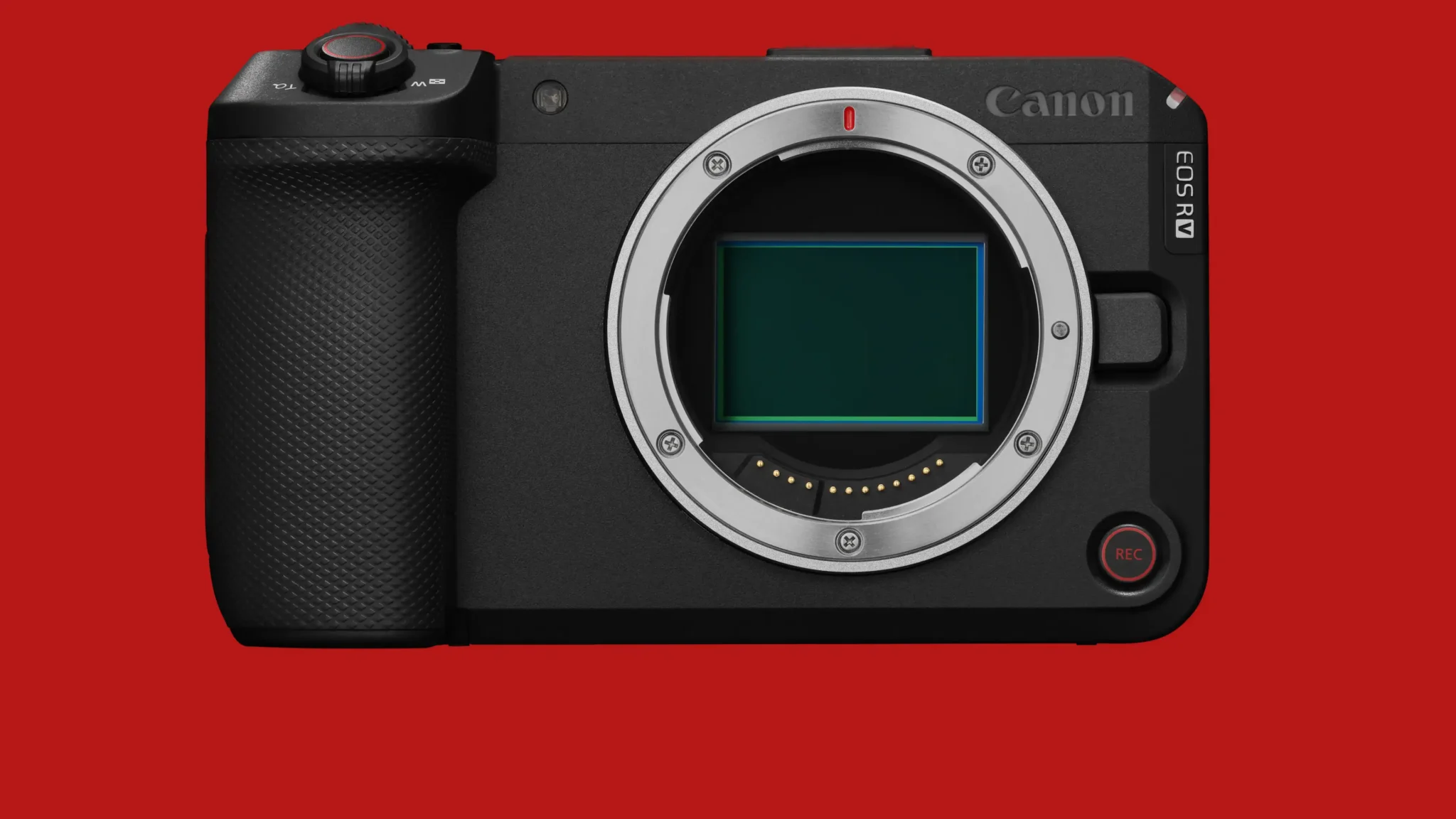


Another week, another camera launch, but Canon’s EOS R6 V announcement has creators frothing about its potential. It’s a video-first version of the R6 III in the body of a smaller EOS C50. This places the camera just out of the cinema range, and that makes it a lot easier for hybrid shooters to manage.
But don’t let its status in the lineup fool you; this is a serious piece of kit for professionals too, and combined with the F 20-50mm f/4L IS USM PZ power zoom lens, it will produce stunning video… and stills if needed.
When you factor in the price, A$3,599 RRP (actually A$3,499 Sale Price) with a RØDE Wireless GO Gen 3 Wireless Mic System thrown in, it’s a pretty compelling camera.
R6 V KEY FEATURES
- Full-Frame: 7K RAW video up to 60p, oversampled 4K up to 60p, and 4K 120p slow-motion.
- Handheld Shooting: Up to 7.5 stops, 5-axis in-body image stabilisation .
- Effortless & Intelligent Autofocus: Dual Pixel CMOS AF II with advanced subject tracking and Eye Detection for precise, reliable focus.
- Optimised for Solo Creators: Compact (688g), intuitive controls, vertical shooting interface, and a front record button for easy self-shooting.
- Flexible Post-Production: Open Gate recording allows easy reframing for various aspect ratios (horizontal, vertical) from a single clip.
- Long-Form & Live Ready: Active cooling, 4-channel audio, and 4K 60p UVC streaming via USB-C for high-quality webcams/live streams.
- Stills: High-resolution 32.5MP stills at up to 40 fps (electronic shutter) with a dedicated Photo/Movie Mode switch.
FOR RISING CREATORS AND PROS
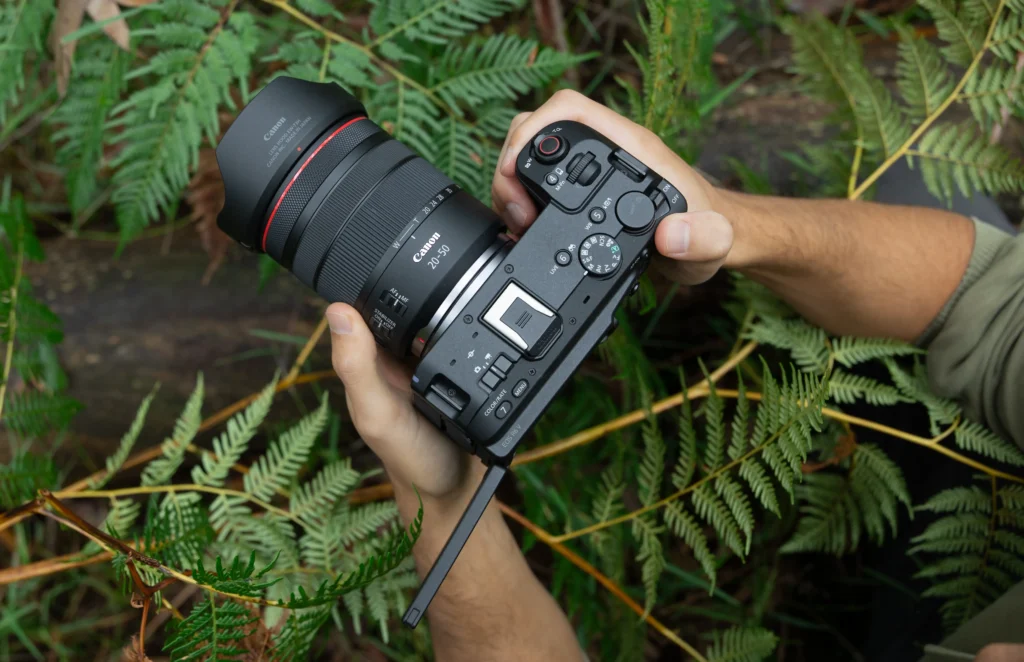
The EOS R6 V might be the video-first version of the impressive R6 III, but I prefer to think of it as the little brother of the EOS C50 because of the similar bodies. The C50 is a true cinema camera, from its menu system and anamorphic support to its locked-down sensor (no IBIS). Most professionals want a sensor that doesn’t move while running and gun operators can’t survive without it. This is why the R6 V is ideal for many creators. Its 5-axis in-body image stabilisation provides up to 7.5 stops of shake reduction, ensuring steady video and sharp stills.
The R6 V offers flexibility for creators thanks to its 7K Full Frame sensor, pumping out a range of aspect ratios. Open Gate recording gives creators the flexibility to reframe horizontal or vertical shots in post-production from a single shot. If you want to shoot vertically, there’s a tripod mount option on the side. It will impact access to the memory card door.
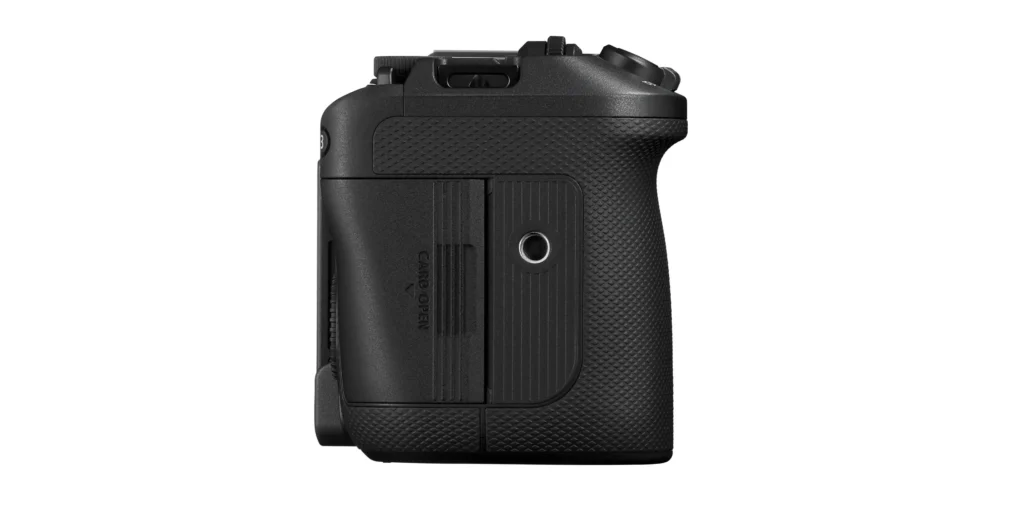
The EOS R6 V offers 7K RAW footage up to 60p, oversampled 4K up to 60p, 2K up to 180p, and fast frame rates up to 4K 120p slow-mo. Autofocus is excellent thanks to the Dual Pixel CMOS AF II system, with intelligent subject detection (people, animals, vehicles) and Eye Detection. Register People Priority prioritises up to ten people for focus.
There are intuitive controls and buttons all over the R6 V, including a zoom lever for compatible lenses. Thanks to the cooling fan, you’ll be able to record long interviews or events at high bitrates and resolutions with dual-card recording and four-channel audio capture. The R6 V’s USB-C interface enables plug-and-play webcam functionality at 4K 60p and supports on-the-go charging and file transfer. A full-size HDMI ensures reliable external monitoring, while the multi-function shoe powers compatible accessories directly.
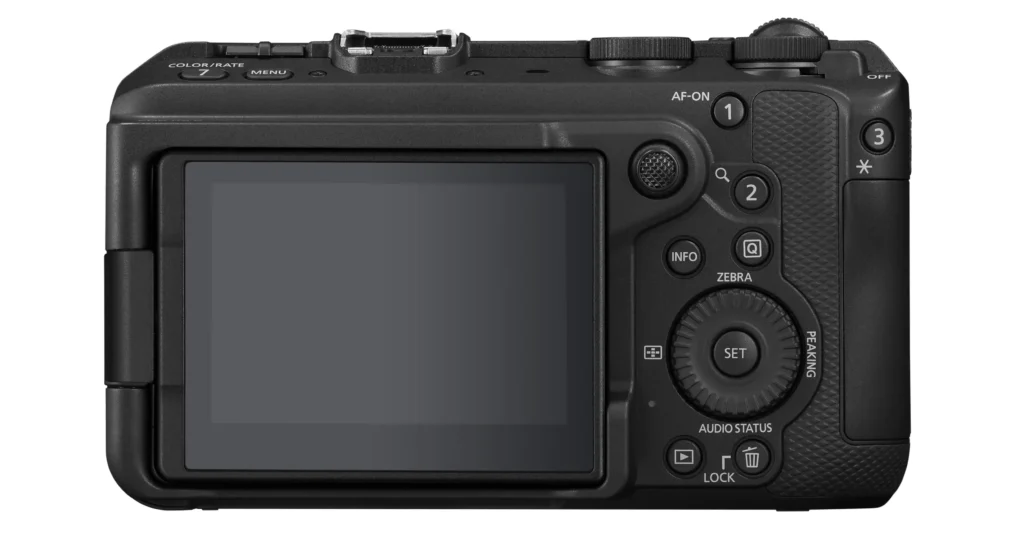
Although this is primarily a video camera, the R6 V also takes 32.5MP stills silently at speeds of up to 40fps. It should be noted that this is electronic shutter only. So flicker and rolling shutter motion issues may arise. Pre-continuous shooting that starts capturing images before the shutter release is fully pressed is another welcome stills function. A dedicated Photo/Movie Mode switch allows users to shift between video and stills without navigating menus. The only other issue I see is the lack of an EVF (Electronic View Finder).
The table below will give a good idea of the differences between the three cameras, which share a lot of key hardware components.
CANON EOS R6 V – EOS R6 III – EOS C50 COMPARISON TABLE
| Feature | EOS R6 V | EOS R6 III | EOS C50 (Cinema) |
|---|---|---|---|
| Continuous Shooting | ⚡ 40fps (electronic) | ⚡ 40fps (electronic), 12fps (mechanical) | ⚡ 40fps (electronic only) |
| Viewfinder | ❌ Not applicable | 👁️ 3.69 million dots | ❌ Not applicable |
| In-Body Stabilisation (IBIS) | Yes (Sensor-shift) | Yes (Sensor-shift) | ❌ No (Digital EIS only) |
| Audio Inputs | 3.5mm Mic Input | 3.5mm Mic Input | 🎙️ 3.5mm Mic Input + 2x Full-Size XLR Inputs (via top handle) |
| Image Processor | DIGIC X | DIGIC X | 🎬 DIGIC DV7 (Cinema Optimized) |
| ISO Sensitivity | 50–102,400 (Expanded) | 50–102,400 (Expanded) | 📊 Dual Base ISO (800 / 6400 in C-Log 2) |
| Timecode Port | No | No | ⏱️ Yes (Dedicated DIN Jack) |
| Dimensions (W x H x D) | 📏 141.8 x 83.3 x 79.7 mm | 📏 138.4 x 98.4 x 88.4 mm | 📏 143.0 x 88.0 x 95.0 mm |
| Weight (inc. battery/media) | ⚖️ 688g | ⚖️ 699g | ⚖️ 737g (670g body only) |
| Sensor Size | Full Frame CMOS | Full Frame CMOS | Full Frame CMOS |
| Resolution | 32.5MP | 32.5MP | 32.5MP |
| Maximum Video Resolution | 7K RAW | 7K RAW | 7K RAW |
| Max Video Frame Rate | 7K RAW 60p; Open Gate 30p | 7K RAW 60p; Open Gate 30p | 7K RAW 60p; Open Gate 30p |
| Max 4K Frame Rate | 120p / 60p / 30p / 24p | 120p / 60p / 30p / 24p | 120p / 60p / 30p / 24p |
| AF System | Dual Pixel CMOS AF II | Dual Pixel CMOS AF II | Dual Pixel CMOS AF II |
| Subject Tracking | Humans, animals, vehicles | Humans, animals, vehicles | Humans, animals, vehicles |
| LCD Screen | 3.0″ Vari-angle Touchscreen | 3.0″ Vari-angle LCD | 3.0″ Articulating Touchscreen |
| Memory Cards | 1x CFExpress B, 1x SD UHS-II | 1x CFExpress B, 1x SD UHS-II | 1x CFExpress B, 1x SD UHS-II |
| Battery Type | LP-E6P | LP-E6P | LP-E6P / LP-E6NH |
| Lens Mount | RF Mount native | RF Mount native | RF Mount native (EF/PL via adapter) |
| Hot Shoe | Multifunction Shoe | Multifunction Shoe | Intelligent Hot Shoe |
| Price | Sale price A$3,499 | Sale price A$3,477 | Sale price A$4,896 |
CANON’S ULTIMATE KIT LENS
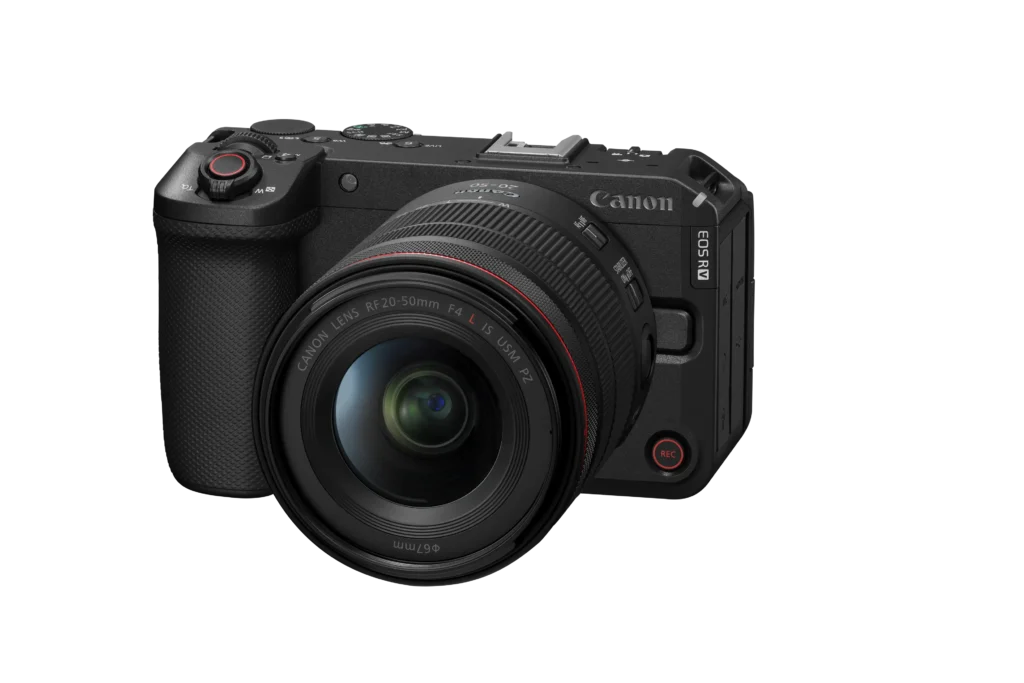
Canon is offering a kit lens option that is quite frankly incredible. The RF 20-50mm f/4L IS USM PZ is Canon’s first full-frame RF L-series lens with an internal power zoom.
The zoom ring operates as both a controlled, steady servo zoom while recording video and a manual zoom-by-wire for precise adjustments when capturing stills or filming. Covering a wider-than-standard 20-50mm focal range at a constant f/4 maximum aperture.
The lens features UD lens elements, Air Sphere Coating (ASC), and optically suppressed focus breathing to maintain a stable frame during zooming. Weighing just 420g, it offers up to 6 stops of optical image stabilisation, ensuring shake-free handheld shooting. Its Nano USM autofocus provides swift, silent, and accurate focusing, down to 0.24 metres.
The on-body controls include a customisable Lens Function button, a manual focus ring, and a dedicated Control Ring for instant access to an assigned setting.
RF 20-50mm f/4L IS USM PZ KEY FEATURES
- Integrated Power Zoom: The first full-frame RF L-series lens with built-in power zoom for seamless video and precise manual control.
- Focal Range: Wider-than-standard 20-50mm zoom at a constant f/4 maximum aperture.
- L-Series Optics: UD elements, ASC, and suppressed focus breathing.
- Compact & Portable: Lightweight (420g) design for comfortable handheld use.
- Effective Image Stabilisation: Up to 6-stops of optical IS for clear, steady results.
- Fast, Silent Autofocus: Nano USM motor for quick, quiet, and accurate focusing.
PRICING AND AVAILABILITY
Due in Australia from mid-June 2026.
- EOS R6 V Body for A$3,599 RRP. RØDE Wireless GO Gen 3 Compact Wireless Microphone System included with purchase while stocks last. Actual sale price A$3,499.
- EOS R6 V and RF 20-50mm f/4L IS USM PZ lens for $5,399.00 RRP. RØDE Wireless GO Gen 3 Compact Wireless Microphone System included with purchase while stocks last. Actual sale price A$5,299.
- RF 20-50mm f/4L IS USM PZ lens for $2,199.00 RRP. Actual sale price A$2,099.