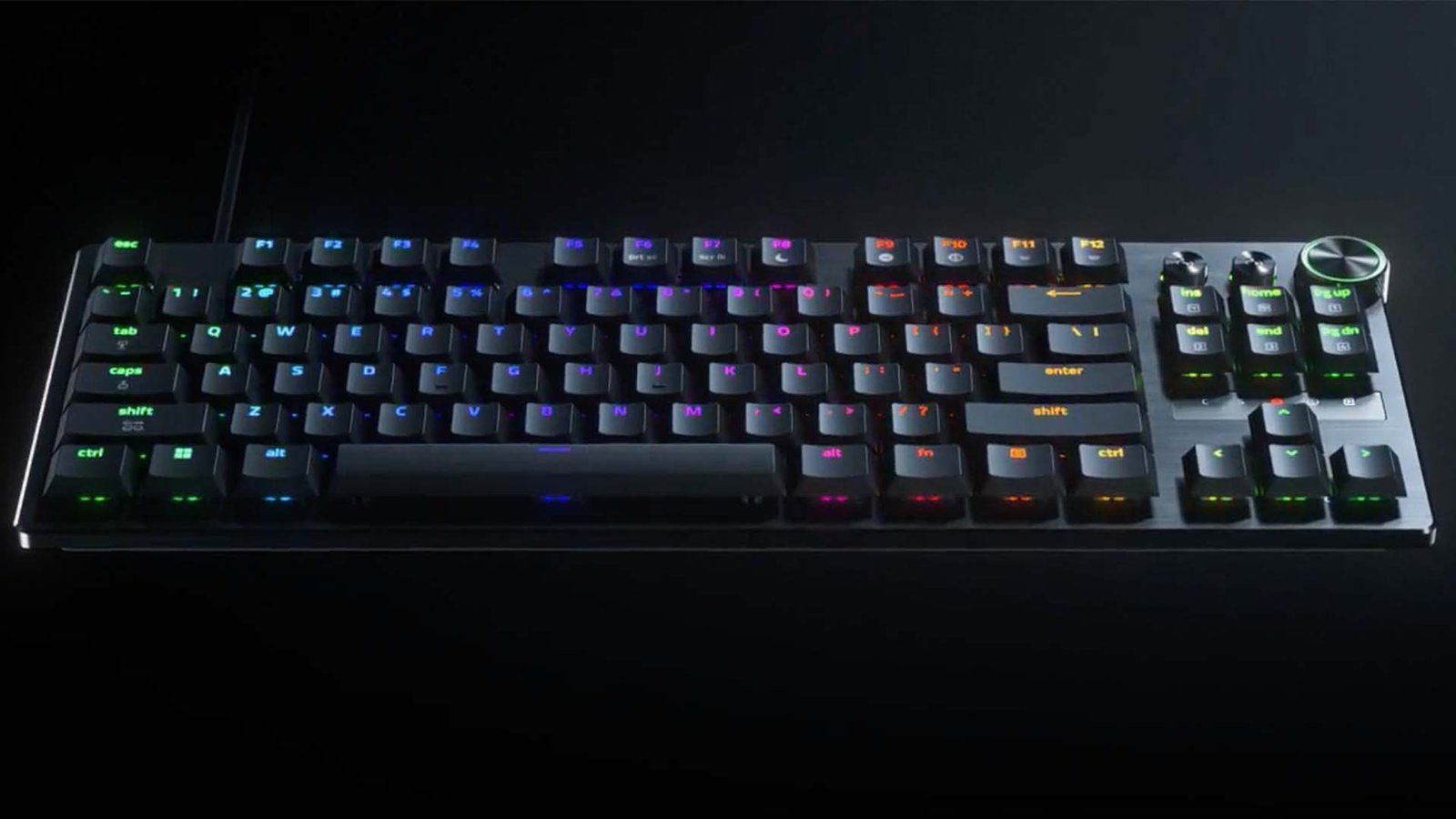

Razer recently launched the Huntsman V3 Pro Low-Profile Tenkeyless 8KHz, marketed as the world’s first low-profile analogue optical esports keyboard. The device is designed to settle a long-standing dilemma in competitive gaming: the choice between the comfort of a slim keyboard and the performance of a full-height one. Razer’s claim is bold — that players no longer need to choose — and the company has leaned on a mix of new switch technology, advanced input control features, and on-stage validation from a reigning Counter-Strike champion to back it up.
The Hardware
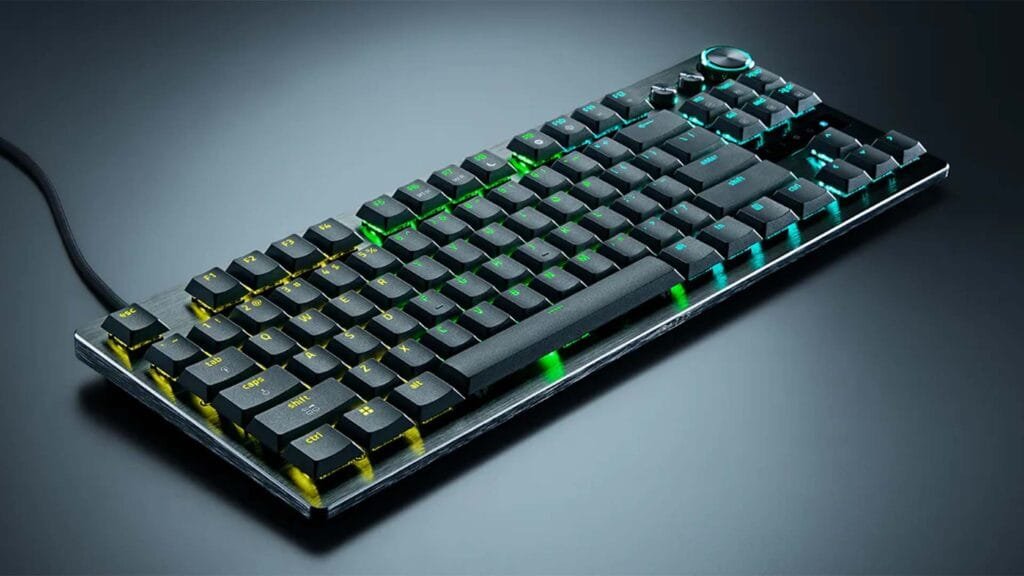
At the core of the Huntsman V3 Pro Low-Profile Tenkeyless 8KHz are Razer’s new Low-Profile Analog Optical Switches, housed in an ultra-slim chassis with a front height of just 19.5 mm and total key travel of 2.8 mm. The reduced profile promotes a more natural wrist position. It minimises finger movement during extended gaming sessions, while lubricated switches, paired with thick internal foam damping, deliver a smoother, quieter typing experience without sacrificing the responsiveness expected of an esports keyboard. The tenkeyless layout further reinforces its tournament-oriented design, shedding the numpad for a more compact footprint favoured by competitive players.
Adjustable actuation ranging from 0.1 mm to 2.8 mm allows players to fine-tune key sensitivity to their preferred playstyle, while Rapid Trigger Mode resets keys based on physical movement rather than a fixed reset point, enabling faster repeated inputs and greater control during high-intensity gameplay. The keyboard also inherits Razer’s Advanced Input Control suite, first introduced on the Huntsman V3 HE Magnetic line.
Razer Snap Flex binds two actions to a single key across press and release for precisely timed sequences, Dynamic Keystroke maps up to four actions based on actuation depth, Instant Cancel Control lets players abort unwanted follow-up inputs mid-action, and Dual-Keypress Priority safeguards intended movement from accidental conflicting keypresses. Onboard profile storage and Razer Synapse Web support round out the hardware package, offering installation-free configuration access from virtually any PC.
Performance
Powered by True 8000 Hz HyperPolling, the Huntsman V3 Pro Low-Profile TKL delivers blindingly fast communication between the keyboard and the system for near-zero-latency performance. Razer claims that in testing with all keyboards set to 0.1 mm actuation, the device recorded an average latency of 0.39 ms, representing a 52% advantage over the nearest competing keyboard tested. That figure is particularly notable given the low-profile form factor, which has historically been associated with compromises in responsiveness.
The keyboard’s competitive credentials extend beyond benchmark numbers. At BLAST Bounty Season 2, MOUZ’s Lotan “Spinx” Giladi competed using an unreleased unit en route to a championship victory, earning the first HLTV MVP award of his career. The nine-time Counter-Strike champion noted that low-profile had always felt natural to him and that the keyboard finally delivered the speed and precision needed to compete at the highest level.
Pricing and Availability
The Huntsman V3 Pro Low-Profile Tenkeyless 8KHz is available through Razer’s official channels and select retailers. The keyboard carries a recommended retail price of A$399.95, positioning it firmly within the premium esports peripheral segment and reflecting its feature set.
Conclusion
Barrie Ooi, Head of Razer’s PC Gaming Division, framed the launch as the definitive end to the long-standing trade-off between comfort and performance in gaming keyboards, stating that for years low-profile meant sacrificing competitive capability and that this product changes that equation entirely. By bringing together adjustable analog optical switches, advanced input control technologies, championship-proven reliability, and an ergonomic form factor trusted by professional players, Razer has set a new benchmark for what a low-profile esports keyboard can be. Whether the broader market embraces that vision remains to be seen, but the early evidence—both in lab testing and on the championship stage—suggests the compromise may finally be a thing of the past.