The speculation is over, and the reactions are flooding in around the world. Sony’s newly launched FX5 is the latest lightweight Full-Frame Cinema Line Camera for TV operators, filmmakers, and documentary shooters. It sits between the FX3 and FX6 in Sony’s lineup with unique specs and features that could make it a huge seller for real professionals in the business.
I say real because this camera isn’t the hybrid the new wave of ‘creators’ want; it’s a camera meant to work in Sony’s high-end production ecosystem. The FX5 has a “newly” developed fully stacked CMOS image sensor with 15+ stops of dynamic range. Dual Gain Shooting mode gives added flexibility when filming in challenging scenes, while three base ISO settings increase the camera’s ability to capture clean video.
The sensor might be only 16.6 megapixels, but it’s likely to be the same as the A7R VI 66.8MP sensor after Sony combined pixels 2×2 for improved low-light performance and speed.
For the first time in Sony’s Cinema Line FX series, the FX5 supports Open Gate shooting. It feels very much like a mini BURANO as well as in-camera recording in X-OCN, Sony’s proprietary RAW format. The camera is capable of shooting in 5K at up to 60 frames per second, in 4K up to 120 frames per second, and in FHD up to 240 frames per second. Updates are planned to add support for HFR shooting up to 240 fps in X-OCN, XAVC S-I recording in a 3:2 aspect ratio (Open Gate shooting), and a frame grab function.
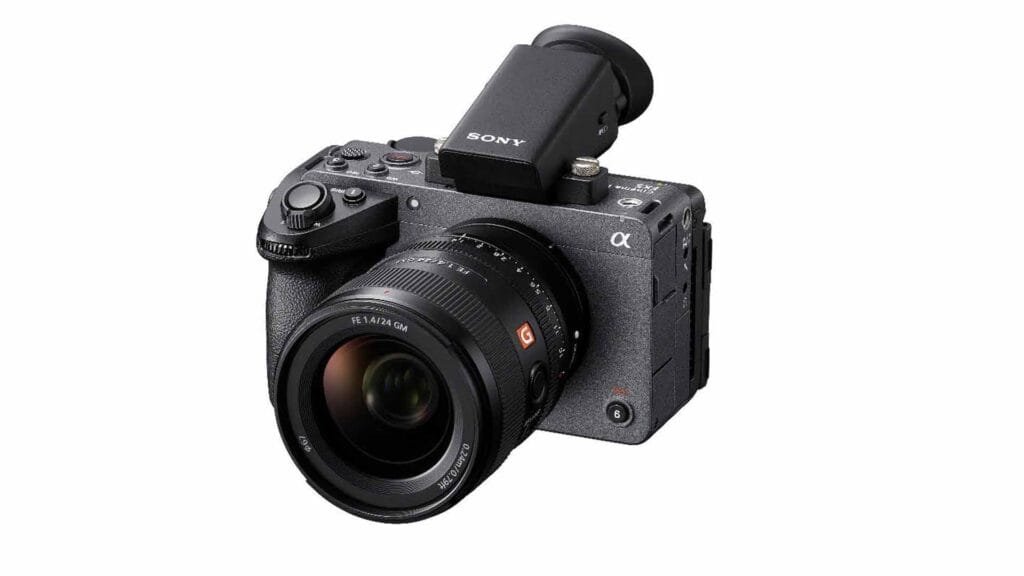
I absolutely hate on-camera monitors. They defeat the purpose of a small, but powerful camera body. The ‘kids’ love them, but I’m an old-school EVF man. Sony has given FX5 users the option of using a 0.58-type EVF with a 7.07-million-dot OLED panel. It attaches above the Multi Interface Shoe. This is a compromise because you can’t use the shoe for audio with the EVF in place. Having said that, the FX5 comes with an extra-wide, 16:9 touch-panel 4-axis multi-angle LCD monitor.
FX5 doesn’t have internal ND like the FX6 or global shutter. The lack of ND is a pain, but I can live with it. When it comes to the lack of global shutter, it’s a non-issue. The readout is about 1.5x faster than the FX3, which is plenty fast enough.
A couple of real cinematographers/pros got their hands on the FX5, and this was their reaction.
Claudio Miranda, ASC, cinematographer of films including “Top Gun: Maverick” and “F1® The Movie“
“I felt that FX5 is a camera that combines high quality image expression and mobility in a compact body, enabling people to use it across a wide range of shooting environments.
Director Gareth Edwards (The Creator, Rogue One: A Star Wars Story, Jurassic World: Rebirth)
“Guerrilla filmmaking just went to the next level, the FX5 is the run-and-gun cinema camera to beat.”
This is a workhorse camera for high-quality output. Below, we’ve laid out the key features and specs.
FX5 Features and Specifications Guide
1. Core Imaging Architecture & Sensor Performance
| Specification | Detailed Technical & Real-World Performance Metrics |
|---|---|
| Camera Classification | Professional Interchangeable Lens Digital Cinema Camera tailored for agile solo operators, multi-cam broadcast setups, and high-end documentary crews. |
| Lens Compatibility | Native Sony E-mount interface, fully optimised to communicate high-speed lens metadata, optical stabilisation, and electronic aperture control across native cinema and photography glass. |
| Sensor & Architecture | 35mm full-frame (35.9 x 24.0 mm) Exmor RS CMOS Fully Stacked Sensor. The architecture separates the pixel array from high-speed processing circuits, drastically cutting down rolling shutter artifacts during rapid pans or tracking sequences. |
| Resolution Dynamics | Approx. 16.6 effective megapixels (4992 x 3328 max pixel count; 18.2 megapixels total). Delivers a 1:1 pixel readout structure optimised for pristine 5K oversampling without line-skipping or pixel binning. |
| Image Processing Engine | Next-generation BIONZ XR2 processor paired with a dedicated AI Processing Unit, doubling computational bandwidth for heavy tracking algorithms and advanced colour pipelines. |
| Dynamic Range & Latitude | 15+ stops of dynamic range when utilising the S-Log3 gamma profile, preserving extreme highlight rolloff and deep shadow details in high-contrast illumination. |
| Colour Science & Temperature | Wide white balance calibration range spanning from 2,000 K to 15,000 K, supplemented by deep-learning Auto Tracing White Balance (ATW) combining visible-light and infrared sensor matrices. |
2. Recording Formats, Resolution & Codec Architecture
| Specification | Detailed Technical & Real-World Performance Metrics |
|---|---|
| Maximum Resolutions & Fps | • 5K Open Gate (3:2) up to 60 fps • 4K / 4.5K (16:9 / 17:9) up to 120 fps • Full HD (1080p) up to 240 fps for high-speed super slow-motion production workflows. |
| Internal RAW & Codecs | Native internal recording of X-OCN (16-bit scene-linear RAW in LT, C1, and C2 variants), alongside broadcast-standard XAVC HS (H.265) and XAVC S (H.264) compression containers. |
| ISO Performance | Triple Base ISO Architecture (800 / 4,000 / 12,800) with an expanded standard video ISO range from 320 to 409,600 equivalent, plus a dedicated Dual Gain Mode for maximum noise suppression. |
| Professional Toolsets | Built-in Proxy Recording, Slow & Quick Motion framing options, comprehensive Timecode (TC/UB) jam-sync capabilities, and uncompressed 16-bit RAW output sent via full-size HDMI. |
| Audio Capture Formats | 4-channel LPCM (48/96 kHz, 24-bit) and professional 4-channel PCM (32-bit float) digital audio pipelines when paired with compatible XLR inputs, rendering clipping practically impossible in unpredictable audio environments. |
3. Autofocus, AI Processing & Monitoring Tools
| Specification | Detailed Technical & Real-World Performance Metrics |
|---|---|
| Autofocus System | Fast Hybrid AF combining high-density phase-detection and contrast-detection points. |
| Coverage & Points | Maximum 759 phase-detection points covering roughly 93% of the image sensor area for edge-to-edge tracking stability. |
| AI Subject Recognition | Advanced real-time tracking with deep-learning Human Pose Estimation (tracking precise eye, head, and body skeletal data), alongside dedicated modes for animals and birds. |
| Focus Assistance | Includes granular AF Transition Speeds, Subject Shift Sensitivity settings, visual Focus Maps, and an in-camera anamorphic lens de-squeeze engine supporting 1.3x, 1.5x, 1.6x, 1.8x, and 2.0x desqueeze factors. |
| Display Panel | 8.8 cm (3.5-type) TFT widescreen touch panel featuring roughly 2.76 million dots housed within an optimised 16:9 cinematic aspect ratio layout. |
| Mechanical Articulation | 4-axis multi-angle flexibility mechanism allowing the screen to flip 98° up, 40° down, 180° to the side, and rotate a full 270°. |
4. Sony DVF-EL1 Electronic Viewfinder – Deep-Dive
| Specification Feature | Detailed Technical & Real-World Performance Metrics |
|---|---|
| Panel Type & Size | High-resolution 0.58-inch OLED panel, delivering deep true blacks, infinite contrast ratios, and zero motion blur during fast pan movements or rapid tracking sequences. |
| Resolution & Clarity | Ultra-dense resolution featuring approx. 7.07 million dots (providing razor-sharp pixel structure critical for pinpoint manual focus pulling and critical framing checks). |
| Brightness & Outdoor Visibility | Extreme daylight visibility peaking at up to 2,500 cd/m² (nits), ensuring HDR gamma profiles and exposure parameters remain accurately judged even under harsh direct sunlight. |
| Colour Science & Grading Support | Native 10-bit colour gradation support paired with a wide colour gamut equivalent to DCI-P3, enabling true-to-life colour evaluation directly in the eye-piece. |
| Magnification & View Modes | Generous 0.90x optical magnification. Features selectable display modes including Standard (for maximum critical detail) and Zoom Out (optimised for enhanced edge-to-edge peripheral visibility). |
| Diopter Range & Eyepoint | Integrated diopter adjustment spanning -4.0 to +3.0 m⁻¹ paired with a comfortable 27.5 mm eyepoint distance, accommodating operators with or without corrective eyewear. |
| Mechanical Articulation | Robust vertical tilt mechanism moving smoothly from 0° to 90°, enabling comfortable low-angle, waist-level, tripod, or shoulder-rig operating positions. |
| Configurable Eyepiece Cup | Fully detachable, reversible eyepiece cup designed for seamless switching between left-eyed and right-eyed shooting preferences. Completely removing the cup allows for closer glass-free viewing. |
| Mounting & Interface | Mounts securely to the top of the camera body via a dedicated proprietary multi-interface port backed down by dual 1/4″-20 anti-twist mounting screws for rock-solid stability on set. |
| Physical Dimensions & Weight | Compact, low-profile footprint measuring 59.9 x 46.1 x 94.9 mm and weighing a featherlight approx. 95.7 g, adding minimal front-heavy strain during handheld work. |
5. Physical Connections, Interface & Power Infrastructure
| Specification | Detailed Technical & Real-World Performance Metrics |
|---|---|
| Media Card Bays | Dual multi-slots supporting standard SDXC (UHS-I/II compliant) cards alongside high-speed CFexpress Type A media cards for heavy RAW data streams. |
| Video & Audio I/O | Full-size HDMI Type-A output, dual 3.5mm stereo minijacks (dedicated microphone and headphone terminals), and a Multi Interface Shoe with a digital audio interface. |
| Data & Network Ports | Dual USB Type-C ports (Port 1: SuperSpeed USB 10Gbps / USB 3.2 data & power delivery; Port 2: Hi-Speed USB 480Mbps utility), plus a dedicated 2.5GBASE-T Wired LAN terminal. |
| Wireless & Streaming | Tri-band built-in Wi-Fi (IEEE 802.11a/b/g/n/ac/ax across 2.4, 5, and 6 GHz bands), Bluetooth v5.3, and direct live-streaming protocols supporting RTMP, RTMPS, and SRT. |
| Power Specifications | Powered by a high-capacity NP-SA100 rechargeable battery pack (delivering approx. 105 mins of actual recording / 170 mins continuous under CIPA standards) with full support for USB Power Delivery (PD) fast charging. |
| Dimensions & Weight | Compact form factor measuring approx. 132.2 x 79.0 x 87.0 mm (grip to monitor). Weighs approx. 643 g (body only) or 734 g equipped with a battery and memory card. |
6. Supplied In-The-Box & Professional Ecosystem Accessories
| Accessory Item | Detailed Technical & Real-World Performance Metrics |
|---|---|
| XLR Handle Unit (XLR-H2) | Detachable top handle featuring dual 3-pin XLR analog/digital inputs, physical audio gain control wheels, and multi-directional mounting points for robust audio workflows. |
| Rapid Battery Charger (BC-SAD1) | Dedicated desktop charging unit built to power up the high-capacity NP-SA100 cells efficiently on location. |
| Rechargeable Battery (NP-SA100) | High-density lithium-ion cell tailored for high power draw operations like 5K Open Gate recording and internal X-OCN encoding. |
| Protective Caps & Covers | Complete kit including the E-mount body cap, shoe cap kit, handle terminal cap, and viewfinder protection elements. |
| Optional Pro Hardware Ecosystem | Supports the dedicated DVF-EL1 OLED Electronic Viewfinder, modular third-party rigging cages (e.g., MID49 extensions) allowing simultaneous use of the XLR audio handle and the dedicated EVF, V-mount power distribution plates, and specialised ARCA/ARRI baseplate support systems. |
PRICING AND AVAILABILITY
The Cinema Line FX5 will be available in Australia from early August 2026.
- Cinema Line FX5 (body only) A$7,849
- Cinema Line FX5 (with XLR handle) A$8,849 AUD
Accessories:
- XLR Handle Unit XLR-H2: A$1,099 available from early September
- Detachable Viewfinder DVF-EL1: A$999 available from early August
- Timecode Adapter Cable VMC-BNCU1: A$129available from mid-August