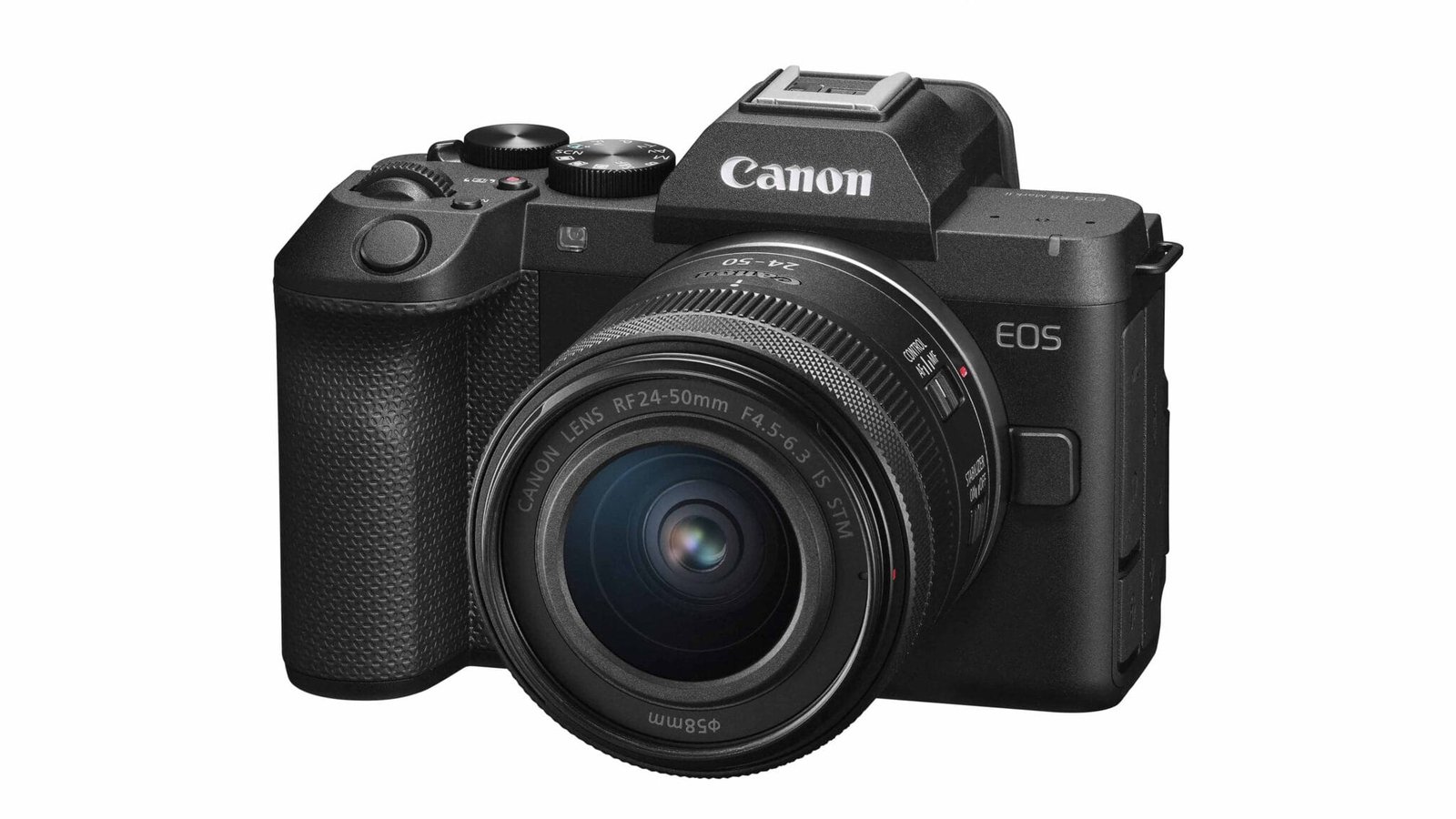


In a couple of weeks, Canon will start selling its new entry-level, full-frame mirrorless camera, the EOS R8 Mark II.
The big question is… did Canon nail the upgrade? So far, opinion is divided about the body. To many, the new R8 design looks similar to the Sony mirrorless shape, but Canon says “the distinctly modern design of the EOS R8 Mark II carries forward Canon’s design heritage while evolving it into a more contemporary form,” so it is a nod to yesteryear.
- ◆Lightweight at approximately 499g (546g with card and battery)
- ◆24.2MP full-frame sensor
- ◆Up to 7.5-stop Coordinated lens and In-Body Image Stabilisation
- ◆40fps continuous shooting, with a bigger buffer than the EOS R8
- ◆Pre-continuous shooting in H+ mode up to 20 frames
- ◆Dual Pixel CMOS AF II with intelligent subject detection
- ◆Filmtone Colour Filters, Custom Picture and Look File (LUT) support
- ◆Wi-Fi® (2.4GHz / 5GHz)[3]and Bluetooth® 5.3
- ◆USB-C® connectivity and charging
- ◆Live streaming options
- ◆Up to 4K 60p video, oversampled from 6K
- ◆Joystick control on rear
- ◆Card slot mounted on side
- ◆Increased buffer
Core Sensor and Stabilisation Upgrades
At the core is Canon’s proven 24.2MP full-frame CMOS sensor paired with the DIGIC X imaging engine. The headline addition to the chassis, however, is a 5-axis In-Body Image Stabiliser delivering up to 7.5 stops of stabilisation at the center (and 7.0 stops at the periphery under CIPA 2024 standards using the RF 24-105mm F2.8 L IS USM Z).
For travel shooters and run-and-gun filmmakers, adding physical IBIS transforms handheld shooting in low light and eliminates the strict dependency on lens-based optical stabilisation.
Flagship Autofocus & Pre-Burst Capture
Canon has trickled down tracking features directly from its top-tier lineup. The autofocus system now operates down to an impressive EV -7.5, putting low-light acquisition on par with the flagship EOS R1.
The inclusion of Register People Priority gives event, documentary, and family travel shooters a distinct advantage: you can preregister key faces, ensuring the AF system prioritizes specific individuals even when they step behind foreground obstacles or wander into dense crowds.
Action capture also sees a significant boost:
- 40fps Burst Rate: Captures high-speed action while maintaining Servo AF tracking across compatible RF optics.
- Half-Second Pre-Capture: In H+ mode, the camera buffers up to 20 frames before the shutter button is fully depressed, cutting down missed reaction shots.
- Deep Learning Persistence: Stickier subject re-acquisition for human eyes, faces, heads, bodies, animals, and motorsports vehicles.
Video Production & 3D Spatial Capture
On the motion side, the R8 Mark II serves as a capable hybrid B-cam. The oversampled 4K 60p footage uses the full width of the 6K read-out for crisp resolution and reduced moiré, while Canon Log 3 provides the dynamic range required for matching color pipelines in post.
Canon is also debuting Dual Pixel 3D imaging technology on the R8 Mark II. By utiliSing the split-photodiode design of the Dual Pixel sensor, the camera embeds parallax depth information directly into still JPEG files. Using Canon’s free Dual Pixel 3D Converter App for Windows (scheduled for release on 8 October 2026), creators can convert standard captures into stereoscopic 3D models and spatial assets.
Pricing and Availability
The R8 Mark II and extras will be available from Canon authorised retailers starting mid-October 2026.
- EOS R8 Mark II Body Only (RRP A$2,529) – Seen for A$2488.
- EOS R8 Mark II with RF 24-50mm f/4.5-6.3 IS STM (RRP A$2,859)
- EG-E2 Extension Grip for EOS R8 Mark II (RRP A$169)
Conclusion
The original EOS R8 was an exceptional value for full-frame image quality, but the absence of sensor-shift stabilisation and an AF joystick kept serious hybrid shooters on the fence. By incorporating 7.5-stop IBIS, the physical multi-controller, EV -7.5 tracking, and robust USB-PD power delivery into a sub-500g body, Canon has turned the EOS R8 Mark II into one of the most balanced, lightweight travel cameras on the market.
The original is still around for A$1,629, and it’s a good camera to start your ‘serious’ mirrorless career. I consider both ‘entry-level’, but if you know what you’re doing, you can use the R8 or R8 Mark II to professional-level standards.